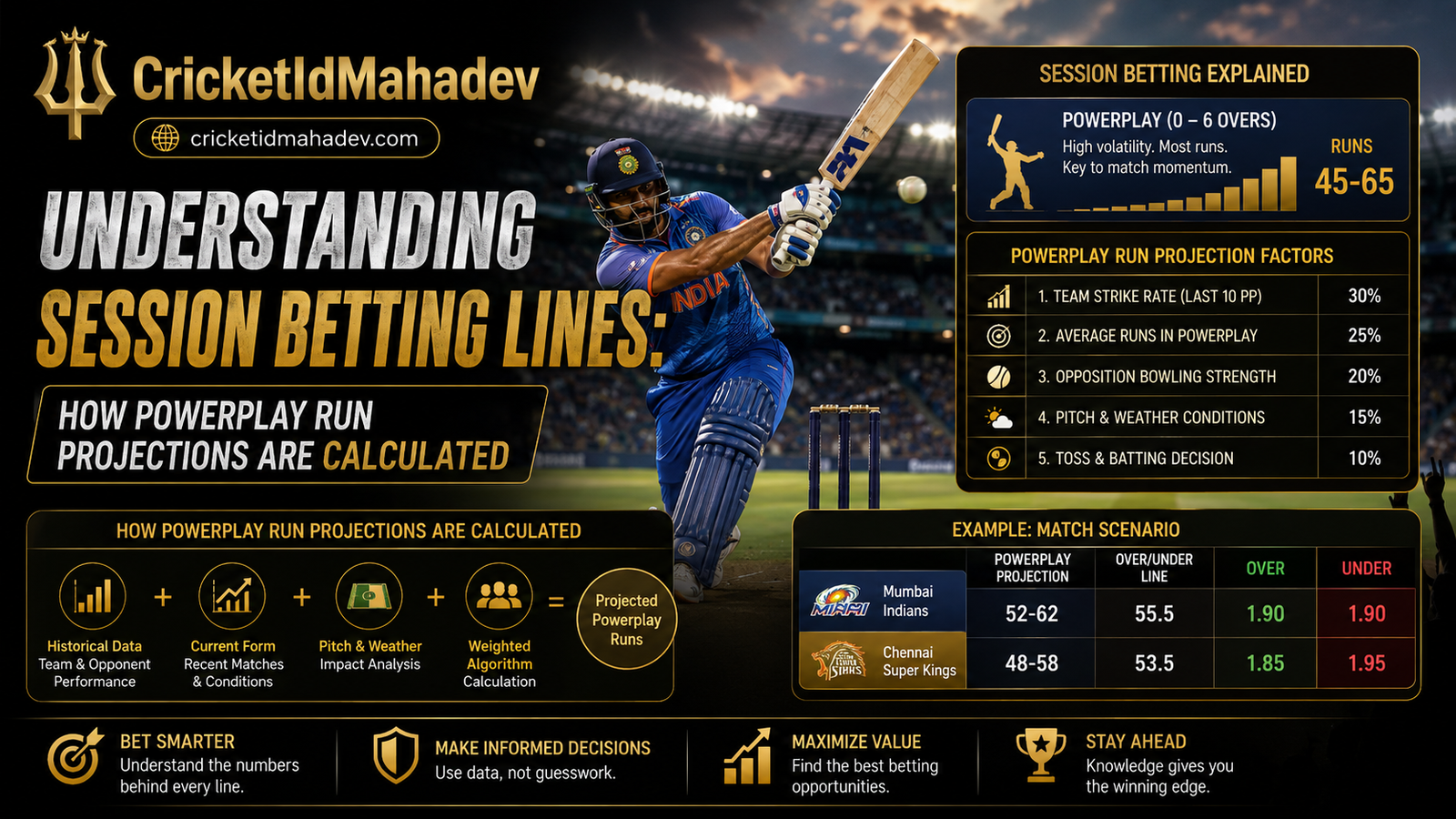
A powerplay run line — something like “48.5 runs in the first 6 overs” — can look like an arbitrary number pulled out of thin air. It isn’t. Session betting lines explained properly means understanding that this number is built from a specific set of inputs, recalculated constantly as conditions and team news come in, not a static guess set once and left alone.
What a Session Line Actually Represents
A session line is the market’s projection for a defined portion of an innings — in this case, the first six overs, known as the powerplay. The number represents the point at which the market considers the outcome roughly a coin flip: score above the line, and “over” bets pay out; score below it, and “under” bets do. The line itself is set to balance expected betting volume on both sides as much as it is to predict the exact outcome.
The Core Inputs Behind a Powerplay Line
Powerplay run projections draw from a combination of historical and situational data, weighted differently depending on how much recent information is available:
Historical powerplay averages at the venue. Some grounds consistently produce higher powerplay scores due to boundary size, pitch pace, and typical outfield speed.
The specific opening pair’s recent form and strike rate. Two aggressive openers with a track record of quick starts shift the projection upward more than reputation alone would.
The opposition’s new-ball bowling attack. A strong opening bowling pairing historically suppresses powerplay scoring, even against in-form batters.
Recent conditions and weather. Overcast conditions that favour early swing bowling typically pull a projected line downward compared to clear, flat-pitch conditions.
Toss result and any late team news. A change to the confirmed opening pair, or a surprise bowling change, can shift a projection in the final hour before a match starts.
Why the Line Moves Even Before the First Ball
Session lines aren’t fixed the moment they’re published. As team news, weather updates, and betting volume come in, the projection adjusts — sometimes noticeably in the final hour before the toss. A line that opened at 46.5 might settle at 49 by the time play starts, reflecting updated information rather than a change in the underlying maths.
How are cricket betting lines calculated once play begins is a related but separate question — live session lines update ball by ball, recalculating based on actual runs scored, wickets lost, and the remaining overs in that specific session window, layered on top of the same historical and situational inputs used pre-match.
Why the Same Ground Can Produce Different Lines Match to Match
Two matches at the same venue, even within the same week, can carry noticeably different powerplay lines. A change in personnel — a different opening pair, a rested strike bowler — carries more weight in the calculation than the ground’s historical average, since venue data is a baseline, not a fixed prediction. Treating a line as “what this ground always produces” rather than “what these specific teams are likely to produce here” is a common misread.
The Bottom Line
A powerplay run line looks like a single number, but it’s the output of several layered inputs — venue history, personnel, conditions, and late-breaking team news — recalculated continuously rather than set once. Understanding what’s actually feeding into that number makes it a lot easier to read than treating it as an arbitrary line drawn in the sand.
Frequently Asked Questions
What counts as the powerplay in cricket?
The powerplay refers to the first six overs of a T20 innings (or the first ten in an ODI), during which fielding restrictions limit the number of players allowed outside the inner circle.
Why do session lines change before a match starts?
Lines adjust as new information comes in — confirmed team news, weather updates, pitch reports, and toss results can all shift a projection in the hours before play begins.
Is a venue’s historical average the main factor in a session line?
It’s one input among several, but personnel factors (specific batters and bowlers involved) typically carry more weight than the ground’s general historical average.
Do session lines keep updating once the match starts?
Yes. Live session lines recalculate continuously based on actual runs, wickets, and overs remaining within that specific session window.
This article is for informational and educational purposes only and does not constitute betting advice. Online betting involves financial risk. 18+ only. Please gamble responsibly.